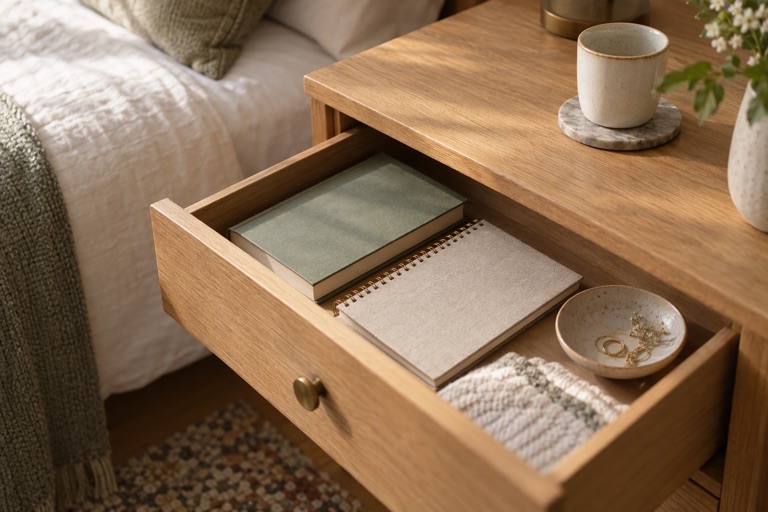
The desk drawer becomes the home for every small thing with no other home: pens, chargers, the cable that fits nothing, the highlighter from 2019. A rotating organiser and one rule — if it has not been used in a year, it leaves — turns the drawer from a junk drawer into a tool drawer you can actually open.
- A rotating caddy reaches everything without digging.
- Chargers in one compartment, pens in another.
- Bin the cable that fits nothing.
- One drawer, one clear-out a year.
Why the drawer fills
A desk drawer is the default home for anything small and unclassified, so it collects chargers for phones you no longer own and pens that dried out last winter. The drawer is not too small; it is too undifferentiated for the mix it holds, and the mix is what makes it a junk drawer rather than a tool drawer.
The first step is a clear-out, not a divider, because a divided junk drawer is still a junk drawer with lanes.
The drawer fills because nothing else claims the small things.
Clear out before you divide
Pull everything out and test it. Dead pens, the charger for the old phone, the cable with no device — these leave. You will halve the contents in ten minutes, and only then does any organiser have a chance, because you are organising things you use, not things you forgot.
Keep a ‘maybe’ pile no bigger than your palm; the rest is a decision deferred that becomes the next mess, and the maybe pile always grows.
Bin the mystery cable first; it fits nothing.
A rotating caddy for the rest
A turntable organiser with compartments holds the survivors: pens and highlighters in one wedge, chargers and cables in another, the USB sticks in a third. Because it spins, you reach the back without digging, which is why the back of a drawer normally stays chaotic and untouched.
Choose one with enough wells for your actual count, not the marketed count; overflow spills and the system fails the day you shove one more pen in.
A turntable beats fixed lanes because the back stops being a dead zone.
Chargers need their own lane
Cables tangle with pens and the result is a drawer you avoid opening. Give chargers one compartment and coil each one, securing the slack, so the drawer opens to a neat set of loops, not a nest that catches your hand. The charger you actually use stays findable instead of buried under the highlighters.
Label nothing, but keep the daily charger in the front well and the spares behind, so the thing you reach for daily is the thing you reach first.
Test each charger against a device before keeping it.
The one-in-one-out rule
A drawer reverts because new small things arrive with no home. The rule: anything new that lands in the drawer means something old leaves. This keeps the count honest and the drawer useful without a yearly drama, because the drift is caught at the moment it happens.
The drawer is for tools you use, not for the things you might use one day, and that distinction is the whole system.
Enforce it the day the drawer feels full again.
When the drawer is shallow
A shallow drawer cannot take a tall caddy. Use flat trays instead, one for pens, one for cables, and slide them. Depth decides the tool; the principle — lanes, not a heap — stays the same, and a shallow drawer done in lanes beats a deep drawer done in a pile every time.
The tray also lifts out as a unit, which is how you clean the drawer in five seconds.
Flat trays are the shallow-drawer answer.
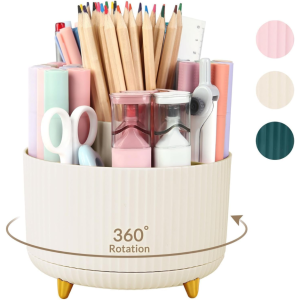
Rotating Plastic Desk Pen Organizer in plastic. Part of the KiKi Living home organisation range. Free US shipping…
See also How to organise a desk with no drawers, and How to stop drawers from becoming a junk layer for the wider picture.
Frequently asked questions
- How do I organise a drawer of pens and chargers? Clear out dead items first, then use a rotating caddy with separate wells for pens and chargers.
- Why clear out before buying dividers? Because a divided junk drawer is still a junk drawer; dividing first just organises the junk.
- How do I stop charger cables tangling? One compartment, each coiled with slack secured, daily charger at the front.
- What is the one-in-one-out rule? Any new item in the drawer means an old one leaves, keeping the count honest.
- What if the drawer is shallow? Use flat sliding trays for pens and cables instead of a tall caddy.