No closet means winter coats have no obvious home, and they are the bulkiest things in the flat. The answer is to hang them where there is no rail and compress the spares, because a coat on a chair is a coat you will trip over until May and a coat in a heap is a coat that creases.
- Hang coats on a freestanding rail or over-door hooks.
- Compress the spares you wear rarely.
- Garment bags keep them dust-free and shaped.
- One chair is not coat storage, ever.
The bulk problem
A winter coat is the largest single item most homes store, and with no closet it ends up on the back of a chair, then the bed, then the floor. The flat is not too small for the coats; it lacks a vertical hang point, and that is fixable without building a closet, because hanging is a wall job, not a room job.
A coat belongs hung or compressed, never draped, and draped is how most coat storage fails.
The chair is where a good coat goes to crease.
Hang without a closet
A freestanding garment rail in a corner holds the coats you wear weekly, and over-door hooks hold the daily one. Neither needs a closet or a drill, and both keep the coats off the furniture, which is the part anyone notices. A rail in the bedroom corner is the closest thing to a closet you can add in five minutes.
Choose a rail with a footprint under 40 cm so it does not eat the room or block the door swing.
A rail behind the door is the classic no-closet fix.
Compress the spares
The coat you wear twice a winter does not need to hang and take a rail slot. A garment bag keeps it shaped and dust-free, and a compression step shrinks it for underbed or top-shelf storage. Two spare coats compressed take less room than one hung, which is how a flat with no closet stores four coats instead of struggling with two.
This is the lever that makes the absence of a closet survivable through a long winter.
Compressed spares live under the bed, not on the rail.
Keep them shaped
Coats lose their shape on a wire hanger or crushed in a bag, and a coat that has collapsed at the shoulders looks like a rag in spring. A broad hanger or a garment bag with a little structure keeps the shoulders from caving, so the coat looks like a coat when you reach for it again.
The small extra care is what makes a no-closet system sustainable past one season instead of becoming a pile.
A suit hanger is worth it for a wool coat.
The daily coat
The coat you wear daily wants the easiest home: an over-door hook by the door, not the bedroom rail across the room. The shorter the trip from door to hook, the less likely it lands on the chair, because convenience is what keeps any system working when you are cold and in a hurry.
A hook by the door beats a perfect rail across the room, because you will actually use the hook and ignore the rail.
The daily coat should never be more than a step from the door.
When the flat is truly tiny
If even a rail will not fit, compress all but the daily coat and store the rest under the bed or on the top of a wardrobe you do have. The daily coat on a door hook is the only one that needs to hang, and that needs no floor at all, so the flat keeps its walking space.
The win is no coat on furniture, which is the part a guest notices before they notice anything else.
No rail, no problem, if the daily coat has a hook.
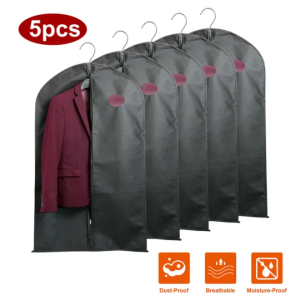
Garment Bags Hanging Suit Bags supplied as a 5-piece set. Part of the KiKi Living home organisation range.…
See also How to store out of season clothes without a spare closet, and How to double your hanging space without a new wardrobe for the wider picture.
Frequently asked questions
- How do I store coats with no closet? Hang daily coats on a freestanding rail or over-door hooks; compress and bag the spares.
- Where do spare winter coats go? In a garment bag, compressed, under the bed or on a top shelf.
- Will compressing coats ruin their shape? Only if over-compressed; a light compress in a structured bag keeps the shoulders.
- Is a garment rail better than hooks? A rail holds several; hooks are best for the one daily coat by the door.
- What is the one rule? No coat on a chair. Hung or compressed, never draped on furniture.