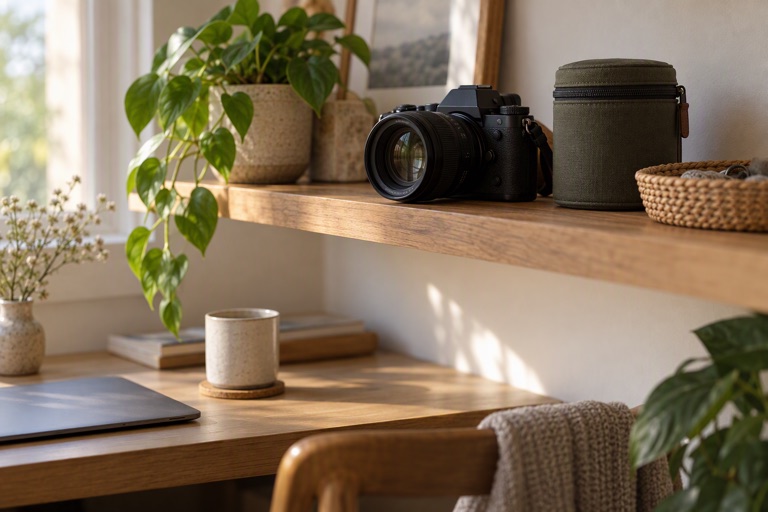
When the floor is full, the wall is the only storage left. Floating shelves turn a blank stretch of plaster into a row of useful surfaces without costing a centimetre of walking room, which is exactly what a small flat needs in the colder months when everything that lived outside moves back in.
- Float shelves at eye, waist and low levels for three zones.
- Keep the heaviest items on the lowest shelf.
- Group by use, not by size, so the wall reads calm.
- A shelf is cheaper than any floor cabinet.
Why the wall is the last free space
In a small room the floor is spoken for: bed, chair, the path between them. The walls are empty by default, and a floating shelf uses that emptiness without reducing the floor you walk on. That is the entire appeal in a one-room flat where every corner already does a job.
Floating shelves also read as lighter than cabinets. A row of open shelves looks like part of the room; a bank of cupboards looks like a wall someone bolted on, which makes a small space feel smaller still.
Renters especially benefit: shelves come down without a trace, unlike a built-in.
Three heights, three jobs
Put a shelf at eye level for the things you reach for daily — books, a speaker, the diffuser. A waist-high shelf takes the heavier, uglier items: a stack of boxes, the router, the modem. A low shelf, about 30 cm up, is for shoes or baskets you slide in and out without bending much.
This vertical split means one wall does the work of a bedside table, a sideboard and a shoe rack, and none of it touches the floor you need to walk across.
Keep the eye-level shelf for the pretty stuff so the wall earns its keep visually.
Weight and fixing reality
A floating shelf is only as good as its fixings. Into a stud or a brick wall it will hold a shelf of books; into bare plasterboard with the supplied anchors it will hold a few light ornaments and not much else, and it will sag. Check what your wall is before you load it, because the failure mode is a shelf tipping at the worst moment.
Rule of thumb: heaviest items on the lowest shelf where a failure is least damaging, lightest on top. A shelf rated for 10 kg at the bottom and 3 kg at the top is a stable wall.
If you cannot find a stud, use a fixing rated for the actual load, not the optimistic box claim.
Group by use, not by size
The temptation is to line up objects by height so it looks tidy. Better to group by function: all the reading things on one shelf, all the morning things on another. A wall organised by use is one you actually use; a wall organised by size is a display nobody touches.
Leave one shelf deliberately emptier than the others. A full wall of stuff reads as clutter; a gap reads as designed, and the eye gets somewhere to rest.
This is the single habit that makes a shelf wall look intentional rather than cramped.
Make it seasonal without redoing it
In late October the same shelves that held summer paperbacks can hold the basket of gloves, the spare scarf, the small heater instructions. Because the shelf is generic, the contents rotate with the season and the structure stays, so you are not buying storage for winter, you are reusing the wall you already have.
That is the quiet win of open shelving in a small home: the frame is permanent, the contents are not, and winter costs you nothing new.
A labelled basket per season makes the rotation a two-minute job.
When a shelf beats a cabinet
A floor cabinet in a small room steals the corner it sits in and the air above it. A floating shelf steals nothing. For anything you access weekly, the shelf is faster to use and cheaper to fit, and it leaves the floor for living rather than for furniture.
The only thing a shelf cannot do is hide the mess. If the item is ugly, put it in a box on the shelf rather than on it, and the wall still earns its place.
A cabinet hides; a shelf displays. Choose by whether the item deserves to be seen.
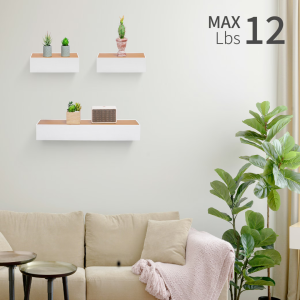
Floating Shelves in wood. Weighs 2.722 kg as shipped. Part of the KiKi Living home organisation range. Free…
See also How to use the wall when you have no floor space, and How to use the space above a door for the wider picture.
Frequently asked questions
- How much weight can a floating shelf hold? Depends on the wall and fixings. Into a stud or brick, a well-fixed shelf holds a row of books; into plasterboard with anchors, keep it light.
- How high should floating shelves go? Eye, waist and low gives three usable zones without crowding the floor or the ceiling.
- Floating shelf or cabinet in a tiny room? Shelf, almost always. It uses wall not floor, costs less, and leaves the corner free.
- How do I stop a shelf looking cluttered? Group by use and leave one shelf partially empty. A gap reads as intentional.
- Can I use floating shelves for winter gear? Yes. Baskets on a low shelf hold gloves and scarves; the structure stays, only the contents change.