Most households do not need a filing cabinet. They need somewhere for the paper that arrives — bills, letters, school forms, receipts — to land, and a second place for the paper that must be kept but is rarely opened. Two containers solve it. The failure mode is having neither, so every sheet ends up on the kitchen counter until it is buried.
- One tray for incoming, one accordion file for keeping.
- Clear the tray weekly — paper does not self-resolve.
- Keep by year, not by category, for personal paperwork.
- Anything you have not opened in a year is safe to shred.
The two-container system
A tiered letter tray holds everything that arrives and has not been dealt with. An accordion file holds everything that has been dealt with but must be kept. That is the whole system: incoming on top, filed behind. The tray is the working surface, the file is the archive. When the tray is full, you process it — you do not buy a second tray. This keeps the volume bounded, which is what makes the system survive.
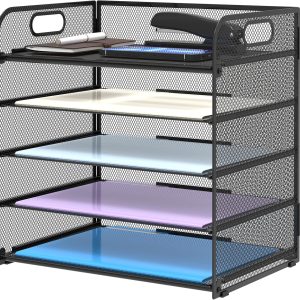
Ships from our US warehouse · 500 g · free US shipping over $49.
Process the tray weekly
Paper only stays controlled if the tray is emptied on a schedule. Once a week, go through it: pay what needs paying, act on what needs acting, file what needs keeping, shred the rest. Ten minutes a week beats a two-hour session every quarter, and it stops the tray becoming a second junk drawer. Put the weekly review in your calendar; the habit, not the product, is what keeps paper from spreading.
File by year, not by category
For personal paperwork, filing by year is faster and more forgiving than filing by category. You rarely need to find a document by type; you need to find it by when. One pocket per year, newest at the front, means a two-year-old receipt takes seconds to locate. Category filing sounds logical and collapses the moment a document fits two categories, which is most of them.
What to keep and what to shred
Keep anything with legal or financial weight: contracts, warranties, tax records, medical notes. Shred anything you have not opened in a year and anything that carries your name and address. A useful test: if you needed it, would you look for it, or would you ask the issuer for a copy? If the latter, shred it. Most people keep ten times more paper than they ever retrieve.
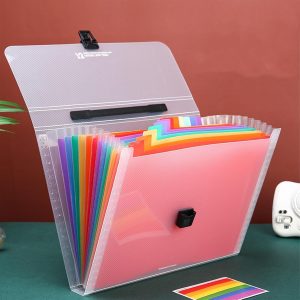
Ships from our US warehouse · 265 g · free US shipping over $49.
Why an accordion file works
An accordion file is a filing cabinet in the thickness of a book. Thirteen pockets expand to hold a couple of years of household paperwork, and it closes down to something you can stand on a shelf. The clear advantage over a box file is that it is expandable and portable — you can take the whole archive to an accountant or a bank in one hand. For most homes it is the right size, and it costs a fraction of a cabinet.
Digital does not remove the paper
Scanning helps, but a surprising amount of paper still arrives and still needs a physical home: signed contracts, official letters, warranty cards. A digital system does not replace the tray, it reduces what ends up in the archive. Keep the two-container system anyway, and let the archive stay small because you shred more of what comes in.
Paper is one of two desk clutter sources — the other is cables, covered in hiding cables in one box. For the whole desk, see desk organizers that stay tidy.
Frequently asked questions
- Do I need a filing cabinet? Usually not. A letter tray plus an accordion file handles most household paperwork.
- How long should I keep paperwork? Tax records for the period your jurisdiction requires; warranties for their term; everything else, ask whether you would retrieve it or request a copy.
- Should I file by category or by year? By year for personal paperwork — it is faster to search and does not create documents that fit two categories.
- How often should I clear the tray? Weekly, in a ten-minute session. A tray that is never emptied becomes a junk drawer.
- Is scanning enough? It reduces the archive but does not remove the tray — signed and official documents still need a physical home.