Most closet problems are not storage problems. They are boundary problems — an item with no fixed place migrates until it lands somewhere it does not belong. Getting belts right removes a whole category of daily friction, and it costs less than the bin you were about to buy.
- Give every category one container, then hold the limit.
- Leave 5 mm of clearance so nothing binds.
- Measure the inside of the drawer, not the cabinet front.
- The back of the door adds capacity without touching the floor.
The real reason a drawer turns into a layer
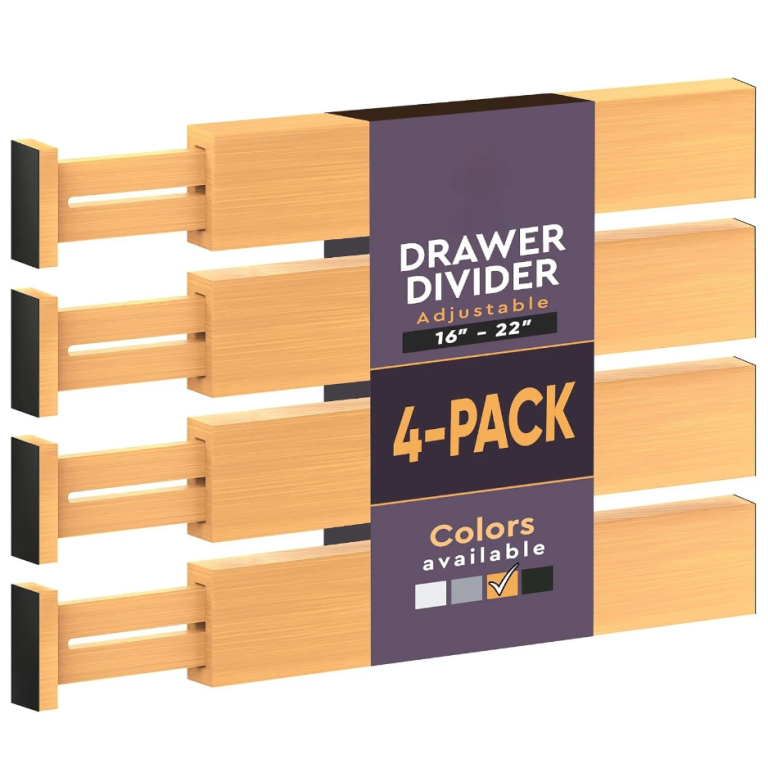
A drawer becomes a junk layer because everything in it is loose. Loose items migrate to the front, mix with each other, and stop having a home. Dividers fix this not by making the drawer bigger but by giving each category a boundary it cannot cross. Once an item has a fixed zone, putting it away becomes one motion instead of a decision, and the drawer stays ordered with no weekly effort.
There is a second cause worth naming: a drawer that is the wrong depth for what it holds. Pens rattle around in a deep drawer, cutlery stacks two-deep in a shallow one, and both end up in a heap. Depth is the number people skip when they buy an insert, and it is the one that decides whether the insert works at all.
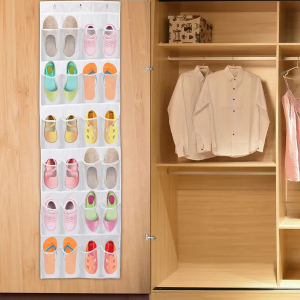
Ships from our US warehouse · 195 g · free US shipping over $49.
One zone per category, and name the categories first
Empty the drawer onto a surface and group what comes out. You will usually find four to six real categories and two or three things that belong somewhere else entirely. Put those back where they belong before you plan anything — it is common to find that a quarter of the drawer does not need to be there at all, which changes the insert you need.
Then give each remaining category a zone sized to its volume, not to its importance. A category that occupies a tenth of the drawer gets a tenth of the drawer, even if it is the one you use most. Items that are used daily go at the front or the outer edge, where the hand lands naturally; the rest can go behind.
How much depth and weight to allow
For belts, plan 30 cm of depth for shoes stored toe-out, 35 cm for heel-to-toe, and 40 cm for tall boots. Weight is the other half: a full over-the-door rack can reach 10 to 15 kg, and a single coat on a hook can be 2 kg. An adhesive hook rated for 5 kg is fine for a towel and wrong for a wet winter coat.
The honest rule for any hanging storage is to halve the advertised rating. Manufacturers test on smooth, sealed, ideal surfaces; a painted plasterboard wall in a steamy bathroom is not that. Halving gives you a margin that survives a humid week and a moment of carelessness.
What to look for in hanging hardware
For belts, the load rating and the fixing are the two things that decide whether it lasts. A wall-mounted rail wants at least two fixings into a stud or a proper wall plug; an adhesive mount is for light loads on smooth, sealed surfaces only. If the wall is plasterboard and the load is a coat, use a fixing, not glue.
Hangers are worth a moment’s thought too. Flocked slim hangers grip woven fabric, hold their shape, and roughly halve the rail space a wooden hanger takes. Wire hangers should be retired — they distort shoulders and slide off a rail. A single box of matching hangers is one of the cheapest upgrades a wardrobe can get.
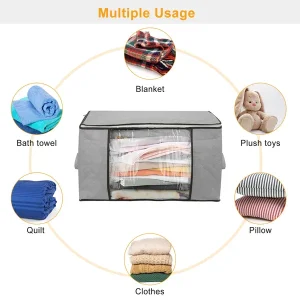
Ships from our US warehouse · 399 g · free US shipping over $49.
How to keep it working after the first week
Most organized spaces drift back within a fortnight, and the cause is almost always the same: one category outgrew its container. When that happens, the instinct is to add a bin. The better move is to remove the overflow. Set a container limit and hold it — if the sock bin is full, a new pair of socks means an old pair leaves. That keeps the system stable without a weekly tidy-up.
The second cause is a container with no home. Anything that has to be moved before it can be used will stop being used. If a bin has to come off a shelf and be opened to reach the thing you need daily, the bin is in the wrong place — swap it for the daily item and put the bin where you can reach it.
When to stop buying and start removing
Storage is not a substitute for editing. Before you buy a fourth bin, take everything out and put back only what you used in the last year. Most people find a full third of a closet is dead weight: clothes that no longer fit, cables for devices they no longer own, and half-used sets. Removing that first means the storage you already have works better, and the bin you were about to buy is often unnecessary.
A useful test for anything you are unsure about is the two-move rule. If you would not move it to a new home, you do not need it in this one. That single question settles more decisions than any amount of clever storage, and it is free.
For a related problem, see How to choose a wall hook for a rented home. It also pairs well with How to choose a hook that does not mark paint.
Frequently asked questions
- Do dividers really help? Yes, but only if they fit. A divider with 5 mm of clearance on each side stays put; one wedged in tight will bind when the humidity changes.
- How many compartments do I need? One per category, not one per item. Six categories in a drawer want six zones, and most trays have more than enough.
- Fixed tray or adjustable dividers? Adjustable, unless you have measured precisely. Drawer widths vary by a centimetre or more even within one kitchen, and an adjustable set fits the drawer you actually have.
- What about a drawer that is too deep? Add a shallow insert and use the space underneath for the seasonal version of the same category. Two layers of one category beats one layer of five.
- How much weight can an adhesive hook hold? Treat 5 kg as 2.5 kg on paint or plasterboard. On tile or glass you can get closer to the rating, but only after cleaning the surface properly.