The storage market is full of products that look right and fit nothing. Choosing the basement deserves ten minutes of thought before you buy, because the numbers that decide whether it works are rarely printed on the packaging.
- Airflow beats fragrance for a musty closet.
- Store shoes toe-out or heel-to-toe — never side by side.
- One box of matching hangers is the cheapest wardrobe upgrade.
- Slim hangers roughly halve the rail space a wardrobe needs.
What decides whether storage works in a closet
Three things decide whether a closet purchase earns its place: whether it fits the shelf you actually have, whether it holds the weight you will put in it, and whether you can lift it once it is full. Almost every disappointing purchase fails on one of those three, and all three are answerable before you spend anything.
The order matters. Fit first, because a container that does not fit the shelf ends up on the floor and makes the closet worse. Load second, because the one specification you cannot fix later is a shelf that bows or a hook that pulls out. Appearance last, because it is the only one you can compromise on without the system failing.
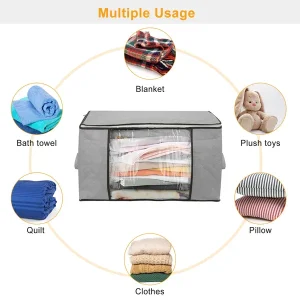
Ships from our US warehouse · 399 g · free US shipping over $49.
Buy for the closet you have, not the one you want
The most common closet purchase mistake is buying for the wardrobe you are planning rather than the one you own. A set of bins sized for an imagined future closet will not fit the current one, and it will sit in a cupboard until it does. Measure the shelf you have today, buy for that, and treat any upgrade as a separate decision made later.
It also helps to buy in ones rather than in sets. A single bin tested in the actual space tells you more than a set of three that you cannot return. Once one fits and works, buy the rest — that is the cheapest way to avoid a cupboard full of almost-right containers.
How to size a bin to the shelf
A bin should be sized to the shelf it lives on, not to the things that go in it. Measure the shelf’s clear height — the gap between it and the shelf above — and choose a bin that stacks two-high inside that gap with a centimetre to spare. That single number is what turns a shelf from a row of single bins into two rows, and it is the most common thing people get wrong.
For the basement, also check the lift. A bin that is full of anything heavy needs a handle or a cut-out, and it needs to be light enough to lift off a top shelf with one hand. If it is not, it will stay on the floor, and the shelf will stay empty. Weight rating matters as much as volume.
What to look for in the container
Three things separate a bin that lasts from one that ends up on the floor. A stiffened side, so it keeps its shape when full. A handle or a cut-out, so it can be lifted off a high shelf with one hand. And a footprint that matches the shelf, so two of them sit squarely side by side. Everything else — colour, window, lid — is preference.
Fabric bins are lighter and softer-edged, which is what you want on an open shelf where a hard plastic corner would look clumsy. Plastic bins are stiffer and wipe clean, which is what you want for anything dusty or damp. The mistake is buying a set of one type for a whole home; most homes need fabric where the bin is visible and plastic where it is not.
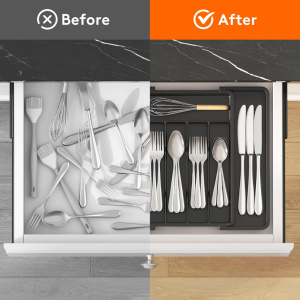
Ships from our US warehouse · 340 g · free US shipping over $49.
Keeping it clean and dry
Fabric storage in a damp room will eventually smell, no matter how good the bin is. The fix is airflow, not fragrance: leave a gap behind the bin, avoid sealing anything damp, and air the space when you can. A sachet of cedar or charcoal helps, but it treats the symptom — a room that stays above about 60 per cent humidity will keep coming back.
Wipe hard surfaces rather than washing them, and lift fabric bins out to vacuum underneath twice a year. Grit and dust collect in exactly the places you cannot see, and a bin that sits on a layer of grit will scratch a shelf every time it is moved. Two minutes twice a year is the whole maintenance schedule.
When to stop buying and start removing
Storage is not a substitute for editing. Before you buy a fourth bin, take everything out and put back only what you used in the last year. Most people find a full third of a closet is dead weight: clothes that no longer fit, cables for devices they no longer own, and half-used sets. Removing that first means the storage you already have works better, and the bin you were about to buy is often unnecessary.
A useful test for anything you are unsure about is the two-move rule. If you would not move it to a new home, you do not need it in this one. That single question settles more decisions than any amount of clever storage, and it is free.
For a related problem, see How to make a closet work when it has no shelves. It also pairs well with How to choose storage for a bathroom with no cabinet.
Frequently asked questions
- What should I check before buying closet storage? Fit, load and lift. Measure the shelf, work out the weight, and check you can get the container down when it is full.
- Does price predict quality here? Only up to a point. A stiffened side and a proper handle cost very little; the money above that usually buys appearance.
- Should I buy a matching set? Only after one of them has proved it fits. Buy one, live with it a week, then buy the rest in the same model.
- How many containers does a closet need? Usually three or four, one per category. More than that and you are storing categories rather than things.
- Should bins be clear or opaque? Clear for anything you need to identify without opening; opaque for the top shelf, where neatness matters more than access. Many homes end up using both.