 1PCS Industrial Chic Black Metal Wall Hook - Saving Wall Mount Organizer
Cable and desk problems share a cause: nothing has a fixed place, so everything stays out. Getting keyboards right is a good place to start, because it is the change that makes the rest of the desk easier to keep clear.
- Design for the ten seconds before a call starts.
- Reusable hook-and-loop straps, never single-use ties.
- Give each person a container, not a shared surface.
- Sort by what happens next: act, keep, discard.
Why a desk stops working before it looks messy
A desk stops working at the point where you have to move something to start a task. That happens long before it looks untidy, and it is usually caused by one zone doing two jobs — the working surface holding things that belong in a drawer or on a shelf.
The signal is a small hesitation. You sit down, and before you can begin you shift a charger, a mug or a pile of paper out of the way. Each of those is a two-second cost that happens twenty times a day, and it is the real reason a desk feels tiring rather than the state of it.
Ships from our US warehouse · 400 g · free US shipping over $49.
Work out from the screen, not in from the room
Plan a workstation outward from the screen. The screen sets the eye line, the keyboard sits a forearm’s length in front, and everything else fills the space that is left. Doing it the other way — fitting the screen into a space already occupied by other things — is why so many desks end up with the monitor pushed into a corner and a nest of cables where the keyboard should be.
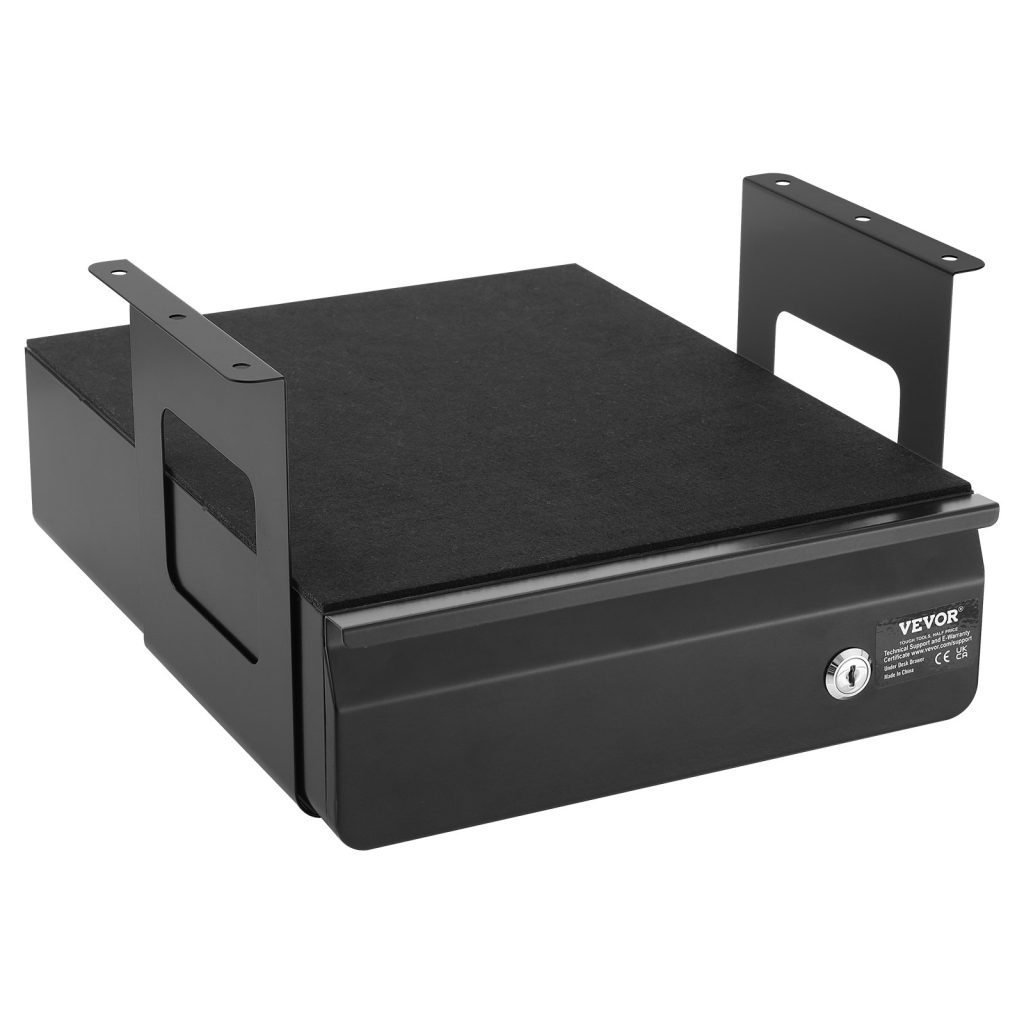
Then take the desk’s own footprint seriously. A monitor on a stand loses the 20 cm of depth underneath it, which is exactly where a keyboard tray or a shallow drawer fits. Raising the screen on an arm or a riser recovers that depth, and it is usually the single change that makes a small desk feel usable.
The two sizes that decide everything
For keyboards, almost everything comes down to two numbers: A4 is 21 x 29.7 cm, and US Letter is 21.6 x 27.9 cm. A tray built for one will hold the other with a little slack, but a tray built for a smaller standard will not. If you handle both, buy for the longer dimension and let the shorter one slide — a document that overhangs a tray will curl at the edge.
Height is the number people forget. A stack of 200 sheets is about 2 cm; a stack of 500 is about 5 cm. Work out how many sheets you realistically keep before you buy, because a 3 cm tray that has to hold 500 sheets will simply be a pile with a tray underneath it.
What to look for in a network enclosure
Ventilation is the specification that matters, and it is the one most enclosures get wrong. Look for slots or a mesh front, not a solid lid, and avoid metal entirely if the router is inside — a metal enclosure acts as a shield. Wood, fabric and perforated board are all fine; a sealed metal box is not.
Size it for the cables as well as the devices. A router plus a modem plus a power brick plus the incoming line needs roughly 30 x 20 x 15 cm of internal space, and the cables need to leave through a gap rather than being pinched at the back. A pinch point on a power lead is a fire risk, not just an untidy one.
Ships from our US warehouse · 500 g · free US shipping over $49.
How to keep it working after the first week
The system fails when something new arrives and has no place to go. Give every new device a default: a spare-charger box, a spare-cable pouch, a tray for paperwork. When there is a named home for the new thing, it goes there; when there is not, it goes on the desk and the desk starts to drift again.
The other habit worth building is the five-minute reset at the end of the day. Not a tidy-up — a reset. Put the day’s objects back in their zones, clear the surface, and leave the cables where they belong. Five minutes daily is less work than an hour monthly, and it is the only maintenance this kind of setup needs.
When to stop buying and start removing
Every desk drawer eventually holds cables for devices you no longer own. Before you buy another organizer, empty the drawer and test every cable: does a device in this house use it, and do you know which one? Anything that fails both questions goes. Most people recover a third of a cable drawer this way.
The same applies to paper. A document box that is full is usually full of things that were kept because keeping was easier than deciding. Go through it once a year, remove what has expired, and the box will stay a comfortable size rather than growing into a second box you did not plan for.
See also How to store spare chargers and adapters, and How to store out-of-season clothes without a spare closet for the wider picture.
Frequently asked questions
- How do I know my desk is failing? When you have to move something before you can start. That is the point to fix, not the point at which it looks untidy.
- What is the fastest fix? Clear the working surface completely and give every object on it a home that is not the desk itself.
- How far should a monitor be? About an arm's length — roughly 50 to 70 cm for most people. Closer than that and the eye has to work harder all day.
- Is a monitor arm worth it? On a small desk, usually yes. It returns the stand's footprint to you, which is often the difference between fitting a keyboard tray or not.
- What size tray do I need for A4? At least 24 x 32 cm internally, to leave a little slack. Anything smaller will curl the corners.