In a small home the scarce thing is not space — it is clear surface. Getting the flat right is one of the first things worth doing, and it costs nothing to try.
- Free-standing and over-the-door storage beats a deposit risk.
- Plan the bathroom outward from the mirror.
- Under the bed and above the wardrobe are usually 400 litres.
- Two baskets, not one — dirty, and clean-but-unput-away.
Why a small room feels smaller than it is
A small room reads as smaller than it is when every surface is doing a job. Storage, seating and work all competing for the same two metres of wall is what makes a space feel tight — not the number of square metres, but the number of things asking for attention at once.
That is why clearing one surface changes a room so much. The eye needs somewhere to rest, and a single empty stretch of wall or counter gives it one. Before you move anything or buy anything, clear the surface you see first and live with it for a week.

Ships from our US warehouse · 450 g · free US shipping over $49.
Plan the bathroom around the mirror
In a small bathroom the mirror is the anchor, because it is the only thing that has to be at a fixed height. Plan outward from it: daily toiletries within reach of the basin, towels within reach of the shower, and everything else behind a door or in a cabinet. Fighting the mirror for wall space is why so many bathrooms end up with a shelf in the wrong place.
Then decide what can leave the room. Spare toiletries, cleaning supplies and anything used monthly do not need to live beside the basin — they need to live somewhere dry and out of sight. Moving one category out of a small bathroom is usually worth more than any shelf you could add to it.
The numbers a small kitchen runs on
A few standard numbers solve most small-kitchen problems. A wall cabinet is 30 to 35 cm deep, a base unit 60 cm, and a worktop 60 cm. The gap between a worktop and the wall cabinet above it is 50 to 60 cm — that gap is the most contested space in the room, and it is where a rail or a shallow shelf earns its place.
For the flat, the number to measure is the counter depth you actually have left. If appliances occupy 40 of 60 cm, you have 20 cm to work with, which is a chopping board and nothing else. Knowing that number tells you whether the answer is a smaller appliance, a wall rail, or moving something out of the room entirely.
What to look for in wall hardware
For a small space, three products do most of the work: a rail with adjustable hooks, a shallow shelf on brackets, and adhesive hooks for the surfaces that will not take a fixing. Buy the rail and hooks as a set so the spacing matches — mixing brands usually means the hooks do not sit where you want them.
Check two specifications before buying anything that holds weight. The load rating, which you should halve for real-world use, and the fixing type, which decides whether it will work on your wall at all. A hook that needs a stud and a hook that takes a plasterboard plug are different products, and the packaging rarely makes it obvious.
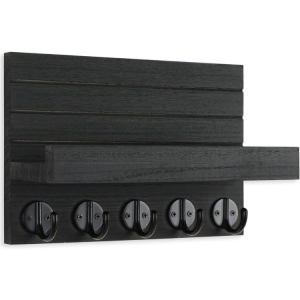
Ships from our US warehouse · 454 g · free US shipping over $49.
How to keep a small space working
Small spaces drift faster than large ones, because there is no slack to absorb anything new. The rule that keeps them stable is one in, one out, applied at the door: if something new comes into the room, something leaves it in the same week. That single habit does more than any storage purchase.
The second habit is a daily reset of one surface. In a small home, one clear surface — the counter, the desk, or the table — makes the whole room feel under control, and it is the surface you should protect above all others. Two minutes a day on that one surface is the whole maintenance routine.
When the answer is not more storage
In a rented home the honest answer is often that the storage you can install is not worth the deposit risk. A wall of drilled shelves in a flat you will leave in a year is a poor trade against a removable system that comes with you. Free-standing, over-the-door and adhesive storage all cost less over a tenancy than making good a wall.
It is also worth asking whether the problem is storage at all. A rented flat that feels cramped is often a lighting and colour problem — one dark corner can make a room read as half its size. A lamp, a lighter wall behind the storage and a mirror opposite the window are cheap changes that do more than another unit.
Related reading: How to store a stroller or buggy in a small flat. It also pairs well with How to choose a bathroom shelf for a rented flat.
Frequently asked questions
- Why does my room feel cramped? Usually because every surface is busy. One clear surface does more for how a room feels than any storage you could add.
- What should I clear first? The surface you see when you walk in. That is the one the eye reads as the state of the whole room.
- Where should a bathroom shelf go? Beside or under the mirror, at about 110 to 120 cm. Anywhere else and it either blocks the mirror or is out of reach.
- How do I store towels in a small bathroom? On a rail behind the door for daily towels, and in a cupboard elsewhere for the rest. Towels take more space than people plan for.
- How deep should a kitchen shelf be? 20 to 25 cm above a worktop. Deeper and you cannot see the back; shallower and a plate will not stand on it.