Bulky seasonal items — the duvet, the coat stash, the decoration box — need a home that is out of the way but reachable. Underbed storage and closet boxes both do it, but they suit different rooms, and picking wrong means a box you cannot get to or a bed you cannot get under.
- Underbed wins for the flat, low, bulky things.
- Closet boxes win when you have a shelf to stack on.
- Both want a clear window or a label.
- Measure the gap before you buy either.
The space each uses
Underbed storage lives in the dead space between floor and bed base — typically 15-25 cm of height and a metre or two of length. Closet boxes live on a shelf or the cupboard floor and stack upward. One uses horizontal dead space; the other uses vertical live space you may not have, and that distinction decides which is right for your room.
If your closet is full, the bed is the free room, full stop.
Most small homes have bed clearance but no shelf room.
Underbed for the flat and bulky
Duvets, winter coats compressed, decoration bags — these are long and flat, exactly the shape underbed storage is built for. A low bag slides in and out without lifting, and a clear window means you see what is in the far end without pulling the whole bag out into the room.
The catch is bed clearance: measure the gap; a bag too tall will not go, and forcing it lifts the mattress and wrecks your sleep.
An 18 cm bag is the safe default for most beds.
Closet boxes for stackable spares
If you do have a shelf, rigid boxes stack into that vertical space and protect breakables the underbed bag would not. They suit the smaller seasonal spares — the spare sheets, the shoe care kit — that benefit from being seen and stacked rather than squashed flat and forgotten.
A box on a shelf is easier to reach than a bag at the back of the bed, if the shelf exists and is not already full of other things.
Boxes also keep out dust and light.
Reachability decides
The best home is the one you will actually open. A bag shoved to the far centre of the bed, never pulled out, might as well be gone. A box on the middle shelf you pass daily gets used. Match the item to the home you reach, not the home with the most room, because storage you never open is storage you paid for twice.
This is why the ‘right’ answer flips between homes depending on the room.
A box you cannot reach is a box you forget.
Clear or labelled either way
Underbed bags should have a clear front; closet boxes should be labelled, because the bottom box is hidden and the far end of the bed is hidden. Without visibility you rebuy the thing you stored, and the storage has failed quietly while costing you the same money again.
Colour-code by season so the October you grabs the orange label, not the green, without opening anything.
A label on a clear box is belt and braces.
Measure first
Before buying either, measure the bed gap and the shelf depth. Most underbed bags are about 18 cm tall; most closets are 30+ cm deep. Buy to the gap and both systems work; buy to the wish and one will not fit, and you will be back online returning it.
The measuring tape is the cheapest tool in the whole job, and the one everyone skips.
Measure twice, buy once.
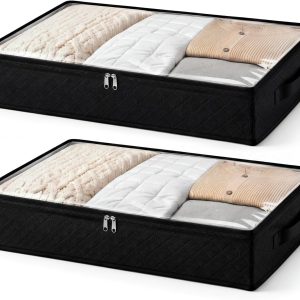
Underbed Storage Bags in clear, supplied as a 2-piece set. Part of the KiKi Living home organisation range.…
See also How to store out of season clothes without a spare closet, and Clear vs opaque storage which is easier to keep tidy for the wider picture.
Frequently asked questions
- Underbed or closet box for bulky items? Underbed for flat, bulky things in a flat with no shelf; closet boxes if you have shelf space to stack.
- What fits under a bed? Low, long items: duvets, compressed coats, decoration bags — typically under 18-25 cm tall.
- Are closet boxes more protective? Yes, rigid boxes stack and protect breakables; underbed bags mostly protect from dust.
- How do I find things in either? Clear window on the bag, label on the box, colour-coded by season.
- What should I measure first? The bed gap height and the shelf depth, so you buy to the space you actually have.